
Sandy Bell's - Edinburgh - Pub Review
Read our Pub review of Sandy Bell's in Edinburgh. Explore its atmosphere, food and drink offerings, customer service, and unique features.
REVIEWSEDINBURGH
5/20/202613 min read
Sandy Bell's, at 25 Forrest Road, EH1 2QH, is not simply another central Edinburgh pub with a bit of background music. It is one of the most famous traditional bars in Scotland, a long-running folk institution whose identity rests on daily sessions, a well-stocked whisky back bar, a respectable cask and draught selection, and a history that stretches back through its earlier lives as the Forrest Hill Buffet and the Forrest Hill Bar. The venue currently opens from noon to 1am Monday to Saturday and from 12.30pm to midnight on Sunday, which gives it the useful double role of afternoon stopping point and late-night folk pub.
Public feedback remains broadly strong, too. TripAdvisor currently carries separate attraction and pub or restaurant listings that sit in the low-to-mid four-star range, while the pub's Facebook page shows a very high recommendation rate. That tracks with Sandy Bell's wider reputation: this is a place people seek out for real Edinburgh atmosphere, traditional Scottish music, and a pub experience that still feels rooted in local culture rather than curated for quick-throughput tourism.
What makes Sandy Bell's especially enduring is that its appeal is not built on reinvention. It is built on continuity. The official history foregrounds the pub's role in the folk revival; contemporary travel coverage still describes it as a cornerstone of Edinburgh's music culture; and current listings continue to present it as a world-renowned folk bar with a distinctly traditional heart. If you are looking for the best pub in Edinburgh for live folk music or an Old Town and Southside whisky bar with actual heritage rather than borrowed character, Sandy Bell's deserves serious attention.
Facilities & Entertainment
If your idea of a great traditional Edinburgh pub is one where the entertainment is woven into the room rather than bolted on for selected evenings, Sandy Bell's is right on target. The pub is officially known for daily folk music sessions, and current listings also note free live music every evening, with extra afternoon or early-evening sessions on several days. Alongside that, the facilities are homely rather than flashy: cask ale, whisky, a real fire, free Wi-Fi, dog-friendly touches including bowls and biscuits, and simple table games such as chess, draughts and backgammon. It is a format that suits conversation, lingering and listening, and it feels far more like an authentic folk bar than a pub trying to manufacture atmosphere through gimmicks.
That atmosphere is not accidental. Historical accounts connected with the pub describe earlier attempts to introduce jukeboxes, fruit machines and television sets, only for regulars to reject that direction because it clashed with the spirit of the place. The current official guidance around sessions makes the same value system clear in a more modern form: the musicians are not simply there as a paid house act, and the pub asks visitors to treat them with the same respect they would show anyone else in the room. In practical terms, that means the focus is still squarely on live traditional Scottish and Irish music, on shared pub culture, and on the organic flow of a real session rather than a stage show.
There is also a subtle but important difference between Sandy Bell's and many city centre bars that advertise music. At Sandy Bell's, music is not an add-on. It is the venue's natural centre of gravity. People come for a pint and stay for the tunes; they come for a dram and find themselves deep in an evening of reels, songs and conversation. They arrive as visitors and, if the room catches them properly, they begin to understand why the pub has become a pilgrimage point for folk fans. That is an unusually strong entertainment identity, and it is the main reason Sandy Bell's remains such a standout option for anyone searching for authentic live folk music in Edinburgh.
Food on Offer
Food is the one part of Sandy Bell's offering that feels deliberately secondary. This is not a gastropub, and it does not present itself like one. The official site foregrounds history, music, beers, whiskies and opening times, while broader travel coverage and recent visitor commentary all suggest that food is modest, changeable and very much behind the drinks and music in the hierarchy of reasons to visit. Taken together, the evidence points to a venue where you should think “folk pub with some food” rather than “pub dinner destination with folk music”.
That said, the food that is associated with Sandy Bell's has always sounded appropriately warming and unpretentious. Travel coverage has pointed to hearty pub staples such as steak and ale pies, while older heritage material tied to the pub mentions Scottish soups and haggis toasties. Older visitor commentary also references toasties and light bar-food style options rather than a full, broad menu. The common thread is clear: when food is available, it tends to lean towards simple comfort food that makes sense alongside real ale, stout, cider and whisky.
For that reason, the safest expectation is a limited food offer rather than a guaranteed full meal. If you arrive hungry and happen to find a pie, a toastie or another warming dish available, that is a pleasant bonus. If you want a substantial sit-down dinner, it makes more sense to eat elsewhere nearby and let Sandy Bell's do what it does best. In truth, that balance suits the pub. A large food operation would probably alter the character of the room, whereas the current emphasis keeps the focus where it has always belonged: on pints, drams, company and music.
Beers on Tap
Although folk music is the headline attraction, the drinks side of Sandy Bell's is stronger than many first-time visitors expect. The official draught list is properly rooted in the Scottish pub tradition, with a mix that normally includes Tennent's Lager, Caledonia Best, Guinness, Innis & Gunn Lager, Schiehallion, Addlestones Cloudy Cider on cask, Deuchars IPA, Harviestoun Bitter & Twisted, Orkney Dark Island, Inveralmond Ossian and a guest ale on tap. That is a substantial spread for a compact traditional Edinburgh folk bar, and it gives drinkers a genuine choice between mainstream draught, Scottish ale, stout, cider and rotating cask.
Current CAMRA information reinforces the idea that beer quality still matters here. The organisation's listing describes four regular real ales and one changing beer, notes that five or six real ales may be available, and identifies regular pours such as Bitter & Twisted, Ossian and Dark Island. That matters because real ale drinkers do not just want a historic room; they want a pub that takes the condition of the pint seriously. Sandy Bell's appears to offer exactly that, which is one reason it works so well as both a music pub and a proper Edinburgh cask ale pub.
Whisky, of course, is at least as central to Sandy Bell's identity as beer. The official whisky page says the bar may have one of the most extensive whisky collections in Edinburgh, with special emphasis on single malts from all six recognised Scottish whisky regions: Speyside, Highlands, Islands, Lowlands, Islay and Campbeltown. The range extends beyond Scotland as well, with bottles from Wales and Japan highlighted on the main page, and the linked spirit list also showing Irish, Indian and other world whiskies. For anyone searching for a whisky pub in Edinburgh that still feels like a pub rather than a tasting room, that combination is highly attractive.
What stands out most is the breadth of the offer. The official spirits menu linked from the whisky page shows plenty of approachable drams in the everyday range, but it also stretches into more serious territory, from Islay stalwarts such as Ardbeg, Bowmore, Caol Ila and Lagavulin to older or premium bottlings that invite a much more expensive night. The menu is set out in 35 ml measures, which feels old-school and generous, and the spread of regions makes it easy to drink comparatively, whether you want sweet Speyside, maritime Island malts, peat-heavy Islay whisky or something lighter from the Lowlands.
This all helps explain why Sandy Bell's has such a strong reputation among drinkers as well as music lovers. It is not a pub that relies on one marquee asset and lets the rest of the offer drift. Instead, the bar seems to understand that real ale, stout, cider and whisky are part of the same cultural ecosystem as the folk sessions. That is why a night here can feel properly rounded: the setting is historic, the music is genuine, and the pint or dram in your hand is not an afterthought.
Price Range, Value & Customer Service
Pricing at Sandy Bell's is best understood as a sliding scale rather than a single bracket. If you are sticking to beer, cider or a modest whisky, this can be a relatively accessible city centre Edinburgh pub. If you decide to explore the upper reaches of the whisky shelves, the spend climbs quickly, which is only to be expected in a bar that carries premium and older expressions. The official spirit list currently linked from the pub's whisky page runs from drams just over the three-pound mark to premium pours above twenty pounds, reaching as high as thirty-seven pounds for a 35 ml measure on one of the older bottles. That is a wide span, and it tells you the bar is catering both to casual drinkers and serious whisky enthusiasts.
In value terms, Sandy Bell's offers something that is harder to price than food portions or happy-hour deals, namely authenticity. You are paying for one of Edinburgh's most storied folk pubs, for a music culture with deep roots, for a historic interior of recognised importance, and for access to a genuinely broad drinks range under one roof. That does not mean every round is cheap, but it does mean the experience carries weight. For many visitors, especially those hunting for a traditional Scottish pub in Edinburgh with real substance, that makes the spend easier to justify.
Customer service is one of the warmer parts of Sandy Bell's current reputation. A recent solo traveller described the staff as welcoming and particularly helpful when recommending a first whisky, while professional travel coverage characterises service as efficient during busy periods and more engaging when the bar is quieter. More recent review aggregation also reflects praise for knowledgeable assistance with unfamiliar beers. The broader picture, then, is of a pub where staff know the drinks, understand that many visitors are curious but not experts, and contribute positively to the atmosphere rather than merely processing orders.
Like many compact, famous pubs, Sandy Bell's can feel brisk rather than leisurely when the room is crammed and the session is in full swing. That is less a sign of poor service than a feature of popularity and scale. Still, the pub seems to handle that pressure reasonably well, and the weight of recent feedback suggests that the staff are one of the reasons first-time visitors relax quickly. In a whisky bar where the shelves can easily intimidate newcomers, that is a genuine asset.
Events & Special Nights
Sandy Bell's is one of those rare pubs where the current events culture cannot really be separated from the venue's history. Officially, traditional music sessions have been taking place here since 1942, and the pub's own history sets out how it became one of the main centres of the folk revival in the United Kingdom during the 1960s. It was then still known by its older Forrest Hill Bar name, yet to insiders it was already Sandy Bell's, and its lunchtime and after-hours culture spilt into nearby flats and kitchen ceilidhs because licensing laws of the period kept pubs shut in the afternoon. This is not just a venue with a nice backstory; the music tradition is embedded in how the place evolved.
The roll call associated with that history is remarkable. The official pub history names Aly Bain, Barbara Dickson, Johnny and Phil Cunningham, Dougie MacLean, Gerry Rafferty, Billy Connolly, Rab Noakes and Dick Gaughan among the notable musicians linked to the pub, while broader cultural coverage also places Hamish Henderson close to the heart of its revival-era identity. In practical terms, this means that Sandy Bell's is not merely a pub where folk music happens. It is one of the rooms in which modern Scottish folk culture was actively shaped, argued over and passed on.
That historical depth still feeds directly into the current sessions. The official music page stresses that every night is unique and unpredictable, which is part of the appeal for anyone who actually loves trad sessions rather than prefabricated live-music nights. The pub highlights the local style sometimes called 'Edinburgh swing', but it also notes that musicians arrive from across Ireland, the wider United Kingdom and much further afield. A good night at Sandy Bell's, then, is not a museum piece. It is a living, changing conversation between local tradition and travelling players.
There is also a clear etiquette to the place, and that helps preserve the quality of the atmosphere. Sandy Bell's explicitly reminds visitors that the musicians are not simply a band paid to entertain the room; it is their night out too, and they should be treated accordingly. That single point explains a lot about the pub's tone. Sandy Bell's is musically generous, but it is not set up as a tourist spectacle. The best way to enjoy it is to join the room, listen properly, and let the music unfold on its own terms.
For practical planning, CAMRA currently lists music from 9pm all week, with additional earlier sessions at 6pm Monday to Thursday, 2pm on Monday, Friday and Saturday, and 4pm on Sunday. The same listing notes daily music sessions during August, which is especially relevant during Edinburgh's festival season. Older heritage material also mentions a slow session on Monday and afternoon weekend music. The exact detail can obviously shift, and the official site itself warns that every guide is rough rather than fixed, but the bigger takeaway is unmistakable: Sandy Bell's is not a pub that 'sometimes does music'. Music is a daily, defining feature of the venue.
Atmosphere & Accessibility
Atmosphere is where Sandy Bell earns its legendary status. CAMRA gives the pub a two-star designation for very special national historic interest and describes it as a small folk music pub barely altered in fifty years. The details of that designation matter: an old gantry, bar counter, vestibule entrance, fireplace and the distinctive pedimented arch dividing the rooms all help preserve the sense that this is a genuine survivor rather than a newly themed traditional bar. Travel writing adds carved wood, panelled walls and a quietly graceful interior, which together create the sort of warm, time-softened setting many visitors hope to find but rarely do.
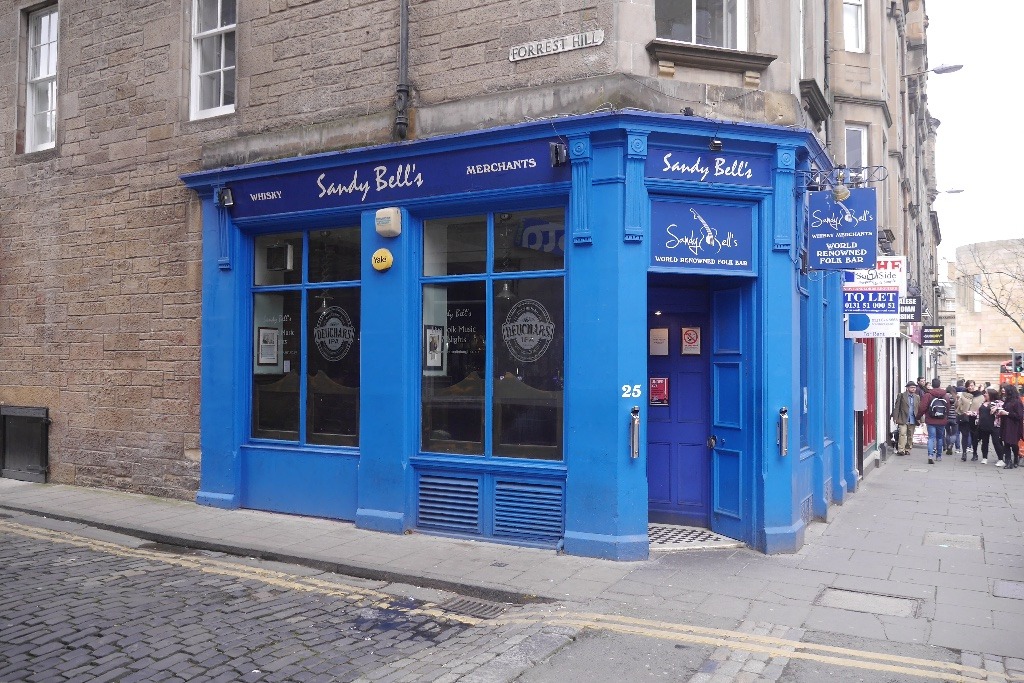
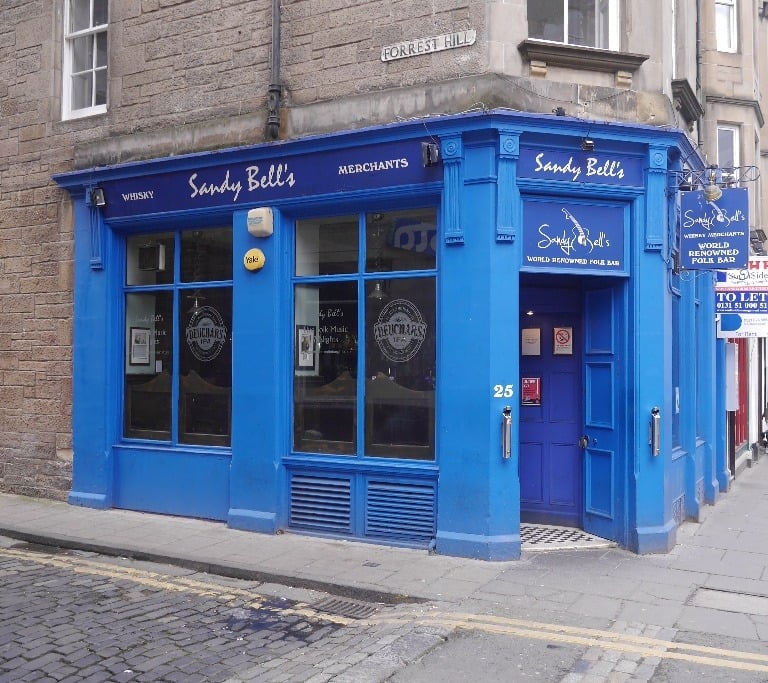
The exterior carries some of that history too. CAMRA notes the revealed ghost signs from the Forrest Hill Bar period, while more recent travel coverage describes the striking blue frontage on Forrest Road. Inside, the pub feels compact, textural and intimate. There is dark wood, a polished bar, and the accumulated visual language of an older room that has been used properly over a long period. Sandy Bell's does not try to impress through scale. It impresses through coherence. Every element, from the archway to the bar fittings, supports the feeling that the room has grown naturally into its role as an Edinburgh folk institution.
That intimacy is a major part of the charm, but it can also become a practical limitation. Recent visitor feedback praises the real Scottish vibe, and newer review aggregation specifically notes that the small-pub feel adds to the experience, but both official heritage descriptions and public comments make clear that Sandy Bell's is a compact venue. When the session is fully going, especially at the back, sightlines can tighten, and breathing room narrows. In other words, the atmosphere gets better as the pub fills up, but your chance of spacious comfort gets worse. Most people who understand the venue's appeal will take that trade happily.
In accessibility terms, Sandy Bell's is in a stronger position than some traditional pubs of similar age. CAMRA states that there is step-free access to the bar and an accessible toilet, while visitor access reviews also score the venue positively for staff helpfulness and reasonably well for its toilet provision. The pub is dog friendly, offers free Wi-Fi, has a real fire, and keeps table games on hand, all of which strengthen the sense of a hospitable local. One caveat is that toilet cleanliness has drawn criticism in some recent visitor feedback, so the quality of the practical experience may vary more than the quality of the music does. Children are also not admitted, which reinforces the grown-up, session-led identity of the place.
Location & Nearby Attractions
The location is excellent. Sandy Bell's sits at 25 Forrest Road, in a position that places it on the seam between the southern edge of the Old Town and the South Side. CAMRA notes that it is about half a mile south of the city centre, with bus stops around twenty metres away, Edinburgh Waverley station roughly 770 metres away and Princes Street tram access around 850 metres away. In practical terms, that means it is easy to reach on foot after a day in central Edinburgh, easy to work into a pub crawl, and easy to leave from even after a late session.
What really strengthens the setting, however, is the concentration of major city landmarks nearby. By simple geography, Sandy Bell's sits within easy walking reach of the National Museum of Scotland on Chambers Street, Greyfriars Kirk on Greyfriars Place, the University of Edinburgh's George Square complex, and the Meadows on Melville Drive. That makes it a natural stop after museum-going, before or after a university-area wander, or at the end of an afternoon around Greyfriars and the adjoining parts of the Old Town. If you are trying to build an Edinburgh itinerary around culture, history and proper pubs, Sandy Bell's is extremely well placed.
Because of that, Sandy Bell's works equally well for locals and visitors. Travellers can get an authentic folk-music pub without leaving central Edinburgh, while residents still get a bar that feels connected to the real rhythms of the city, especially the university quarter and the South Side. During busy festival periods, that position becomes even more useful, not least because August brings daily music sessions. In short, as a Forrest Road pub with serious cultural appeal and excellent walkability, Sandy Bell's has one of the strongest locations of any traditional pub in Edinburgh.
Overall Impression
Sandy Bell's is an excellent pub, but more importantly, it is a very specific kind of excellent pub. It is not the place for a polished gastropub dinner, expansive seating or a generic city-night-out formula. What it offers instead is rarer and more memorable: a genuinely historic Edinburgh folk pub where traditional music still matters, where the drinks list has real depth, and where the room itself feels inseparable from the culture it houses. For anyone searching for authentic live Scottish music in Edinburgh or a whisky pub with real atmosphere rather than merely good branding, that is a powerful combination.
Its strengths are substantial. The music pedigree is extraordinary, the sessions are frequent and still rooted in living tradition, the beer range is far stronger than casual visitors might expect, the whisky selection is one of the pub's great assets, and the interior remains full of historic character. Add the central Forrest Road location, the welcoming style of service reported by many recent visitors, the dog-friendly touches and the sensible late opening hours, and it is easy to see why Sandy Bell's continues to be recommended so widely.
The drawbacks are real but relatively minor. Food appears limited and variable; the compact layout can feel crowded once the session fills out, and some recent comments suggest the loos do not always match the quality of the music or the charm of the bar. Still, none of those points undercuts the core appeal. Sandy Bell's remains one of the best-known traditional pubs in Edinburgh for very good reason. It offers warmth, musical depth, quality drinks and a sense of continuity that is becoming increasingly rare. If the question is whether Sandy Bell's is worth visiting, the answer is yes, emphatically so, provided you go for the right reasons: tunes, atmosphere, heritage and a very good pint or dram in one of the city's great folk rooms.
© 2026. All rights reserved. All other trademarks and copyrights are the property of their respective holders.
Please drink responsibly. This website promotes pub culture and community responsibly. If you or someone you know needs support, visit https://www.drinkaware.co.uk