
The Scotia - Glasgow - Pub Review
Read our Pub review of The Scotia in Glasgow. Explore its atmosphere, food and drink offerings, customer service, and unique features.
REVIEWSGLASGOW
7/3/202612 min read
The Scotia on Stockwell Street is one of those rare Glasgow pubs that feels woven into the city’s identity rather than simply placed within it. Established in 1792 and widely presented as Glasgow’s oldest pub, it stands in the city centre at 112 to 114 Stockwell Street, close to the River Clyde, St Enoch, and the old entertainment quarter that helped shape its reputation. The claim to being Glasgow’s oldest pub is not entirely uncontested, but the venue’s long lineage, enduring cultural importance, and unmistakably historic character are beyond dispute.
What makes The Scotia especially compelling is that its history is not only old but also unusually vivid. In its earlier years it served sailors, merchants, dock workers and passing travellers; later it became a neighbour to the Scotia Music Hall, then the Metropole Theatre, drawing performers and audiences into the bar. By the 1960s and early 1970s it had become associated with writers, folk singers and socialist political groups, helping to cement the long-running image of The Scotia as a pub where Glasgow’s music, politics and conversation could all collide in the same room.
Today, The Scotia remains a highly active Glasgow city centre pub rather than a preserved relic. It currently opens from 11:00am every day, closing at midnight from Sunday to Thursday and at 1:00am on Friday and Saturday, with serving hours from noon onwards. Its current review profile is strong as well, with the venue listing a 4.6 out of 5 rating from more than 2,000 reviews and a 91% positive score. That combination of heritage and present-day popularity is a large part of its appeal.
Facilities & Entertainment
The Scotia’s facilities are not about polished modern luxury. They are about giving people the essentials they actually want in a proper Glasgow pub: a central bar, dependable drinks, live music, places to settle in, and enough character that the room itself becomes part of the entertainment. Current venue information highlights free Wi-Fi, disabled access, plug sockets, and app ordering, while broader pub listings also note that the venue offers a snug, close-set seating around the L-shaped bar, and a layout that has retained much of its old-world feel.
Entertainment is where The Scotia really distinguishes itself from countless other city centre pubs. Glasgow tourism listings describe it as a live music pub with performances running from Thursday to Sunday, while the venue’s own current listings highlight Friday night music from 9.30pm, two Saturday live sessions at 4.30pm and 9.30pm, and Sunday music from 5pm. In other words, this is not a pub that treats live music as an occasional add-on. Music is central to the place, and that long-standing identity remains visible in the way it is promoted and programmed now.
There are also smaller touches that suit the pub’s conversational, sociable style. Games available at the venue include dominoes, chess and backgammon, which feels very much in keeping with a historic pub that values time spent talking, singing, listening and lingering rather than rushing people in and out. Another distinctive detail is that visitors have, in tourism coverage, even been encouraged to borrow instruments and make their own music, which says a great deal about the venue’s loose, participatory spirit.
One practical detail worth knowing before you go is that The Scotia does not accommodate under-18s because of licensing restrictions currently noted on its menu pages. Dogs are welcome under the venue’s broader pub policy, though separate pub listings note that live music can affect that dog-friendly access, so it is sensible to check before visiting if you plan to bring one along. That slightly adult, music-led atmosphere is part of what gives The Scotia its particular feel.
Food on Offer
Food at The Scotia appears to follow the same principle as the rest of the pub: keep it straightforward, satisfying and suited to a historic live music venue rather than trying to turn the place into a full gastropub. The current venue description emphasises pub classics and good value, while serving hours run from noon until close each day. That suggests a food offer designed to support long afternoons, pre-music meals and easy city centre drop-ins, rather than fine-dining ambition.
What can be said with confidence is that pizza is specifically listed for both lunchtime and evening service, and the current venue pages continue to present the menu as a range of pub favourites rather than a narrow speciality offering. Older restaurant coverage, while not a live menu, reinforces the longstanding impression that The Scotia caters to people looking for comforting, unfussy food with a Scottish pub bent rather than a fashionable tasting experience.
That matters because it fits the room and the clientele. In a pub like this, the best food is often food that knows its role. People come to The Scotia for history, pints, music, atmosphere, and the sense that they are drinking in one of Glasgow’s most storied boozers. A menu of hearty pub staples and easy crowd-pleasers makes far more sense than anything overly self-conscious. In that context, the food offer feels like a supporting act that does the right job.
There is also enough on the wider menu infrastructure to suggest reasonable inclusivity. Venue FAQs confirm non-alcoholic drink options and a no gluten-containing ingredients menu, with allergen information available to check before ordering. So while The Scotia trades heavily on heritage and atmosphere, it is still operating as a contemporary pub with the basics visitors now expect around choice and dietary clarity.
Beers on Tap
For anyone searching for a historic Glasgow pub with proper beer credentials, The Scotia has plenty going for it. Current pub listings state that it serves four changing beers rather than relying on one fixed regular lineup and that those changing beers typically feature Scottish breweries such as Broughton, Cromarty and Loch Lomond. That rotating approach keeps things interesting and helps the pub feel plugged into Scotland’s wider brewing scene rather than tied to a static corporate drinks list.
The setting matters here too. Beer in The Scotia is not only about what is in the glass but also about where you are drinking it. A pint in a room with low ceilings, dark wood, old match strikers along the bar, a terrazzo spittoon trough at the base of the counter, and decades of live music history carries a different kind of appeal from the same pint in a generic bar. For real ale drinkers and visitors looking for an authentic Glasgow pub experience, that heritage gives the drinks offer extra weight.
Alongside cask ale, the broader drinks range is wide enough to suit mixed groups. The current drinks menu includes bottles such as Old Speckled Hen, Desperados, Sol, Heineken and Peroni Nastro Azzurro, alongside cider names including Kopparberg, Old Mout and Bulmers. Spirits are also a central part of the offer, with gin, rum, vodka and whisky all given substantial space, and the menu explicitly tells guests to ask at the bar for the malt whisky selection. In a pub that advertises cask ales, live music and malt whisky on its frontage, that feels entirely on brand.
There is also a sensible no- and low-alcohol line-up for those not drinking booze. The drinks menu includes alcohol-free sparkling wine; alcohol-free lager options such as Peroni Nastro Azzurro 0.0% and Heineken 0.0%; and a run of mocktails, including Magic Berry Punch, Apple Berry Spritz, Passion Fruit Cooler and Elderflower Nojito. So although The Scotia feels gloriously old-school, it is not stuck in the past when it comes to accommodating how people drink now.
Price Range, Value & Customer Service
In price terms, The Scotia appears to sit in the affordable to lower mid-range bracket for a live music pub in Glasgow's city centre. Exact draught pint pricing is not surfaced in the accessible current menu text, but the drinks menu provides a useful benchmark: house wine starts at £11.99 a bottle, with 175 ml glasses from £3.29; prosecco starts at £4.99 for a 20 cl bottle; mocktails are £2.99; standard signature cocktail glasses start at £3.99; and some of the slightly more premium cocktail serves start at £4.49. Those are the sort of prices that suggest a pub aimed at regular trade and casual drop-ins rather than a high-ticket night out.
That value proposition has long been part of the pub’s appeal. Older restaurant commentary described bargain bar food and a no-frills authenticity, while current venue messaging still leans hard into value for money. In a city centre context, that matters. A historic pub with regular live music can sometimes slip into trading almost entirely on atmosphere. The Scotia seems to understand that repeat custom depends on balancing atmosphere with prices that still feel fair.
Customer service appears to be one of the venue’s stronger assets. Recent review summaries point to a high overall score and a strong positive share, while visitor comments repeatedly mention friendly staff, a welcoming atmosphere and service that adds to the pub’s charm rather than simply processing orders. That is important in a place like this because heritage and reputation can get people through the door once, but warm service is what makes a historic pub feel alive rather than merely famous.
There is also something about The Scotia’s identity that makes good service more noticeable. Pubs with this much history can sometimes lapse into trading on legend. When staff remain personable and the room still feels welcoming to first-timers as well as regulars, the place avoids that trap. The best accounts of The Scotia describe it not as a museum piece but as a working Glasgow pub where people still feel looked after, and that does a lot for the overall experience.
Events & Special Nights
If you had to identify the single thread that ties The Scotia’s long history together, it would probably be performance. The pub’s association with entertainment goes back to its proximity to the old Scotia Music Hall and later the Metropole Theatre next door, which brought theatre people into the bar and linked the venue to the performing arts early on. That connection even stretches into wider showbiz history: Stan Laurel’s father managed the Metropole, and a blue plaque was unveiled at The Scotia in 2022 to commemorate Laurel’s beginnings in Glasgow show business.
The folk reputation came later and remains even more central to the pub’s mythology. During the 1960s and 1970s, The Scotia became a haven for folk singers, poets and politically engaged groups. Billy Connolly and Gerry Rafferty both performed there with The Humblebums, and the pub is still regularly cited as one of the places where that chapter of Glasgow’s folk story took shape. That is a serious part of the venue’s cultural capital, not just a handy anecdote for tourists.
The radical politics side of the pub’s identity is equally important. Tourism and heritage coverage alike describe The Scotia as having a history of radical politics, and Glasgow's historical records go further by identifying it as a haven for socialist political groups in the 1960s and early 1970s. That mixture of music, politics and literary conversation gives the pub a very particular Glasgow flavour. It is not just old. It is old in a way that reflects the city’s argumentative, artistic, working-class self-image.
In the present day, the events side still centres on live music. Current venue information promotes regular performances across the weekend, while city tourism coverage frames the pub as part of Glasgow’s live music offer in the historic city bars category. Coverage elsewhere also describes The Scotia as one of Glasgow’s premier live music venues, with styles ranging from rock and country to blues and folk. That breadth matters because it suggests the pub has evolved without abandoning its roots. The folk aura is still there, but it has not become narrowly nostalgic.
Atmosphere & Accessibility
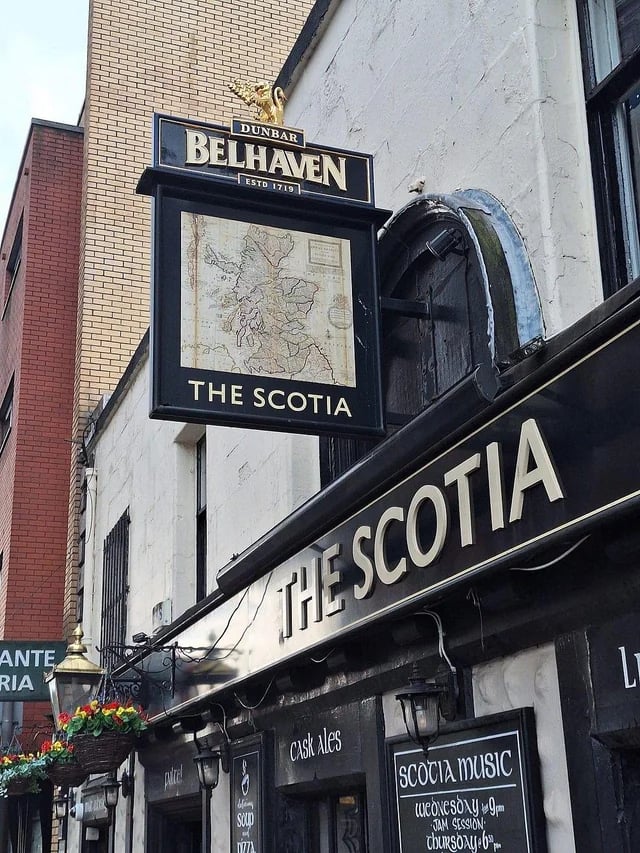
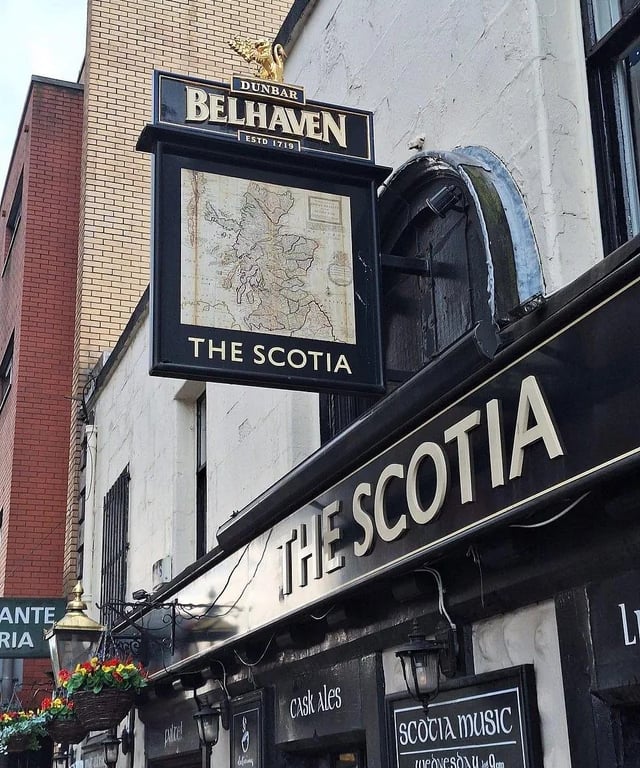
Atmosphere is where The Scotia earns its status as a genuine destination pub in Glasgow. Externally, it has that slightly timeworn, instantly recognisable frontage that tells you you are about to walk into somewhere with stories. Inside, the room is defined by low ceilings, wood panelling, dark wooden benches, a compact L-shaped bar and a cosy snug. It is exactly the sort of setting many people picture when they search for a traditional Glasgow pub, but so few places still deliver convincingly.
The heritage details are unusually rich. The pub’s mock-Tudor frontage and a number of interior fittings date from a 1929 refurbishment, while later work in 1987 helped re-establish the venue after another closure. Historic interior notes describe match strikers along the top of the bar counter, a terrazzo spittoon trough at the base, a mirrored back gantry, partitions that create smaller drinking spaces, and a tiny snug on two levels. These are the kinds of details that give a pub texture and memory. They make the room feel shaped by generations rather than designed in one go.
That sense of preservation is significant enough that the interior is classified as of very special national historic interest, receiving a two-star historic interior rating. The building is not formally listed, but the interior reputation tells you a lot about what survives inside. For lovers of old pubs, that is a major draw in itself. The Scotia is not simply trading on the date above the door. It still contains the physical signs of age that make a historic pub visit satisfying.
The mood seems to balance cosiness and liveliness especially well. Review language repeatedly talks about character, warmth and a proper welcoming atmosphere, and that fits the kind of room. The Scotia appears to be. Because live music is central to the venue, the atmosphere can shift from quiet afternoon pint territory to busy, singalong evening energy. That flexibility is one reason it works for both locals and visitors. It can feel like a proper neighbourhood pub and a Glasgow nightlife stop in the same day.
Accessibility is best described as promising but worth checking in advance if you have specific needs. The venue currently lists disabled access but also notes in its wider accessibility guidance that older pubs can vary and that guests are encouraged to call ahead. Wi-Fi is available, the pub operates app ordering, and dogs are allowed under venue rules, though live music times can affect that. So while The Scotia is absolutely usable as a modern city centre pub, it is still operating within the physical realities of a very old building.
There is even a dash of ghost lore around the place, which feels oddly fitting. Reports have circulated of spectral figures in the snug and along the bar, and while that obviously sits more in the realm of pub mythology than hard necessity, it contributes to the sense that The Scotia has accumulated stories in every corner. In another venue that kind of detail might feel gimmicky. Here it just feels like one more layer of atmosphere.
Location & Nearby Attractions
The Scotia’s location is strong enough that, even without the history, it would still be a useful city centre pub. It sits on Stockwell Street in central Glasgow, with St Enoch Centre right on the doorstep and public transport close at hand. Current pub listings place St Enoch subway around 400 metres away and Argyle Street station at roughly the same distance, making the pub very easy to reach for shoppers, commuters, gig-goers and weekend visitors.
Its immediate setting also adds to the appeal. Visit Glasgow describes The Scotia as being across the road from The Clutha, another historic bar with deep music associations, which means this little pocket of the city carries an outsized amount of cultural weight for pub lovers. Anyone doing a Glasgow pub crawl focused on heritage and live music could happily make Stockwell Street one of the anchors of the evening.
Because it is so central, The Scotia works well as either a starting point or a final stop. You are close to shopping at St Enoch, close to the Clyde, and firmly within Glasgow city centre’s wider mix of streets, nightlife and attractions. The venue is even marketed as being about a 14-minute drive from Celtic Park, which gives it another practical use for people looking for a pre-match or post-match pub with more character than the average sports-led drink stop.
There is also a broader symbolic value to the location. Atlas Obscura notes that the pub stands on one of Glasgow’s four original streets, at a time when the Clyde was a major shipping thoroughfare. That means a visit to The Scotia is not only geographically central but historically central too. Few pubs in the city can as convincingly connect modern Glasgow nightlife to the older mercantile, theatrical and working river city that came before it.
Overall Impression
The Scotia is not the sort of pub that tries to impress through trendiness, polish or reinvention. Its strength lies in remaining unmistakably itself. If you are looking for a historic pub in Glasgow city centre with real atmosphere, live music, cask ale, and a story that genuinely matters to the city, this place has a very persuasive case. It feels lived in, culturally important and still properly used, which is a far more difficult balance to strike than many pubs manage.
It also earns points for avoiding the trap that catches some famous old pubs. The Scotia has every reason to become complacent. It can market itself on age alone, on Billy Connolly and Gerry Rafferty alone, or on the “oldest pub in Glasgow” line alone. Yet the current picture suggests a venue that still invests in live music, still maintains a changing beer selection, still brings in positive reviews, and still functions as a real pub rather than a heritage prop.
There are, of course, a few caveats. If you want broad family access, The Scotia’s under-18 policy makes it unsuitable. If you need certainty on full accessibility details, it is wise to call ahead. And if you are seeking a sleek modern gastropub menu, this is almost certainly not the right fit. But those are not flaws so much as part of the venue’s identity. The Scotia is, first and foremost, a historic Glasgow pub for adults who want atmosphere, conversation, music and drink in a room with real provenance.
Taken as a whole, The Scotia remains one of the most distinctive pubs in Glasgow. It carries the city’s folk history, a streak of radical politics, links to theatre and literary culture, a nationally important historic interior, and a continuing commitment to live performance. For visitors wondering where to find an authentic Stockwell Street pub, an atmospheric live music pub in Glasgow city centre, or simply one of the most memorable old pubs in Scotland, The Scotia more than justifies the attention it gets.
© 2026. All rights reserved. All other trademarks and copyrights are the property of their respective holders.
Please drink responsibly. This website promotes pub culture and community responsibly. If you or someone you know needs support, visit https://www.drinkaware.co.uk